Online Brand Reputation in 2026: What Changed, What Broke, and What to Do About It
- LdotR
- 3 days ago
- 11 min read

For twenty years, managing brand reputation meant managing page one of Google. Own the first ten links, and you largely owned the story.
That model has quietly stopped working, and two numbers explain why. First, when Google displays an AI Overview, the zero-click rate rises to roughly 83% — meaning most people get their answer without visiting any website, including yours. Second, industry research indicates 27% of brands have already been misrepresented in AI-generated responses.
Read those together and the implication is uncomfortable: your reputation is increasingly being summarised by systems you cannot see, to audiences who never reach your site, and in more than a quarter of cases the summary is wrong.
Online brand reputation in 2026 is the sum of how your brand is represented across AI-generated answers, search results, reviews, social platforms, marketplaces, and news — including representations created by impersonators and counterfeiters rather than by you — and managing it now requires monitoring and correcting sources you do not own.
This guide covers what actually changed, the second front most reputation programmes ignore entirely, what Google officially says (versus what the industry claims), a six-step framework, and how to measure reputation when clicks are no longer the signal.
What Actually Changed About Online Brand Reputation in 2026?

Three shifts, arriving together, broke the traditional model.
Shift one: the answer replaced the link. Roughly 58.5% of US searches and 59.7% of EU searches now end without a click, rising to about 83% when an AI Overview appears, per industry analyses. Gartner has forecast zero-click searches reaching 75% by 2026. Organic click-through rates have fallen sharply — reported averages range from roughly 34% to 38.8% declines where AI Overviews appear. Your carefully crafted page still exists; fewer people ever see it.
Shift two: citation became the new ranking. Research indicates brands cited within AI Overviews saw trust scores rise by up to 3.7 points, while uncited brands in the same query categories lost both traffic and trust. Being summarised favourably is now worth more than ranking third.
Shift three: audiences got sceptical of the summary. Consumer trust in AI search reportedly fell from 82% to 54% in a year, and Gartner has found that 53% of US consumers distrust or lack confidence in the reliability and impartiality of AI search results. Users increasingly verify what AI tells them — which makes your owned and third-party sources matter more, not less.
Taken together: fewer people visit your site, more people receive a machine-written characterisation of your brand, and many of them then go looking for corroboration. Online brand reputation in 2026 is therefore about ensuring that both the summary and the corroboration are accurate.
(Note: figures in this section come from industry research and analytics vendors rather than primary academic sources; treat them as directional. The Google guidance cited below is primary.)
The Second Front: Reputation Damage You Didn't Cause

Here is the blind spot in almost every reputation programme: a growing share of reputation damage now originates from people pretending to be you.
Traditional reputation management assumes the negative signal is genuine — an unhappy customer, a critical journalist, a competitor's campaign. Increasingly it is not. It is a counterfeit product sold under your name that fails and generates a one-star review. It is a phishing site using your logo that defrauds a customer who then blames you publicly. It is a fake support account on social media mishandling complaints in your voice.
The scale of that fraud economy is documented. The FBI's 2025 Internet Crime Report recorded total losses surpassing $20 billion, with phishing losses rising 208% on essentially flat complaint volume, and 85% of losses coming from cyber-enabled fraud that exploits human trust rather than technical compromise. Every one of those incidents involved a victim who believed they were dealing with a legitimate brand.
The reputational asymmetry is brutal: you absorb the damage without ever having had the customer relationship. No refund you issue, no apology you post, and no PR campaign addresses a review left by someone who bought a fake.
This is why online brand reputation in 2026 cannot be separated from brand protection. Monitoring sentiment tells you that trust is falling; monitoring impersonation tells you why. LdotR's online brand protection practice exists at exactly this intersection — detecting and removing the counterfeit listings, phishing sites, and fake accounts that manufacture bad reputation faster than any communications team can repair it.
What Google Actually Says About AI Visibility
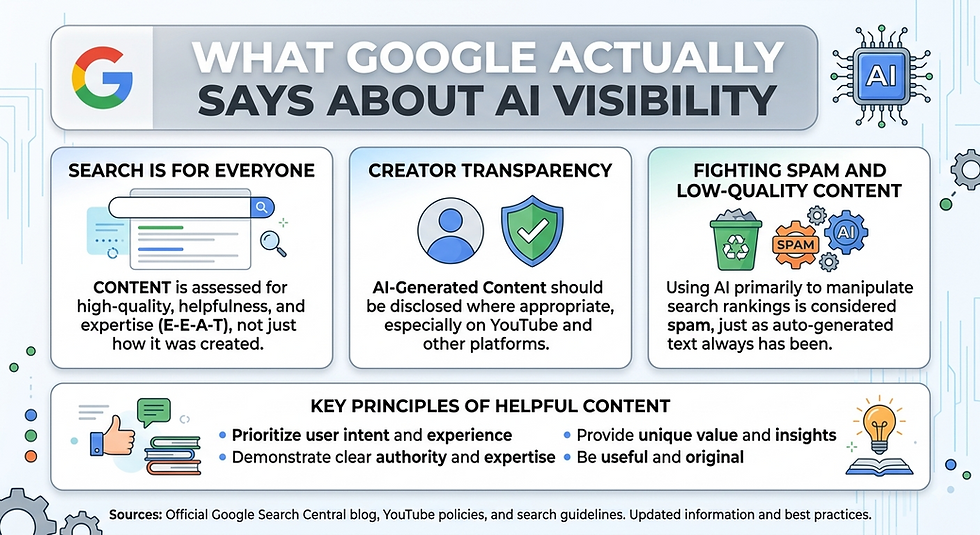
Before buying anything sold as "AI optimisation," read the primary source — because Google's official position contradicts most of what the industry is selling.
Per Google Search Central's guidance on AI features, there are no additional requirements to appear in AI Overviews or AI Mode, and no special optimisations necessary.
There is no separate AI index and no AI-specific markup. The same helpful, people-first content and standard structured data that ranks in organic Search is what surfaces in AI features, drawn from the same index and judged by the same E-E-A-T signals. Google also notes that clicks originating from result pages containing AI Overviews tend to be higher quality, with users more likely to spend time on the site.
Two practical conclusions follow:
Ignore vendors selling proprietary "AI schema," LLM-specific markup, or guaranteed citation placement. Google says these do not exist. Content quality, demonstrable expertise, structured data, and technical accessibility remain the levers.
Site owners retain control. Standard controls — nosnippet, data-nosnippet, max-snippet, and noindex — govern what can be shown from your pages.
The honest implication for online brand reputation in 2026 is less exciting and more useful than the hype: the work is publishing genuinely authoritative, well-structured, accurate content — and making sure the other sources AI systems draw on are accurate too. Which brings us to the part most brands neglect.
Where Online Brand Reputation Is Actually Formed

Reputation now forms across seven surfaces, and most brands actively manage only two of them.
Surface | What shapes perception | Who typically owns it internally |
AI answers | How assistants summarise your brand | Nobody |
Search results | Rankings, snippets, People Also Ask | Marketing / SEO |
Review platforms | Ratings, recent reviews, responses | Customer service |
Social media | Mentions, comments, fake accounts | Marketing |
Marketplaces | Listings, seller ratings, counterfeit reviews | Sales / e-commerce |
News and forums | Coverage, Reddit and community threads | Communications / PR |
Impersonation infrastructure | Fake sites, phishing, lookalike domains | Nobody |
Two rows have no owner in most organisations — and they are the two that increasingly determine outcomes. AI answers because the discipline is new; impersonation infrastructure because it sits between security, legal, and marketing.
Note also that AI systems draw on the surfaces below them. A cluster of negative reviews caused by counterfeits, or a Reddit thread about a phishing scam using your name, can be synthesised into the AI summary that becomes millions of users' first impression. Fixing the source is upstream reputation management — and it is more effective than trying to influence the summary directly.
The 6-Step Framework for Managing Online Brand Reputation in 2026

Step 1: Audit what the machines say about you
Query the major assistants — Google AI Overviews and AI Mode, ChatGPT, Perplexity, Claude, Gemini — with the questions your customers actually ask: "is [brand] legitimate," "[brand] reviews," "[brand] vs [competitor]," "[brand] complaints." Record what comes back, which sources are cited, and what is inaccurate. Most brands have never done this once. It takes an afternoon and routinely surprises executives.
Step 2: Fix the sources, not the summary
You cannot edit an AI answer. You can correct what it draws from: outdated information on your own site, incorrect business details, unanswered reviews, inaccurate third-party profiles, and stale Wikipedia or directory entries. Since AI systems use the same index and E-E-A-T signals as Search, improving source accuracy is the only durable lever.
Step 3: Strengthen genuine authority signals
Named authors with real credentials, publication and update dates, citations to primary sources, and consistent entity information across platforms. This is E-E-A-T work — unglamorous, and the actual mechanism behind AI citation.
Step 4: Monitor the impersonation layer
Watch for lookalike domains, cloned sites, counterfeit marketplace listings, fake social accounts, and fraudulent apps — the manufacturing plant for reputation damage you did not cause. LdotR's brand monitoring and intelligence platform covers 300M+ domains, 75+ marketplaces, and 25+ app stores, analysing DNS records, SSL certificates, traffic patterns and usage history.
Step 5: Remove fakes fast
Speed determines how much reputational damage compounds. Registrar and host takedowns for live phishing and cloned sites, platform complaints for counterfeit listings and fake accounts, and domain recovery through UDRP, URS or national policies via trademark protection in the domain space. Every day a fake operates, it produces more victims — and more permanent negative signal.
Step 6: Secure your authentic footprint
Registry locks and DNSSEC on critical domains, email authentication at enforcement, verified social accounts, and governed domain portfolios through corporate domain management. A clean, verifiable footprint makes your brand easier for both humans and machines to distinguish from imitations.
How Do You Measure Reputation When Clicks Disappear?

Traffic was always a proxy for reputation. In a zero-click world, it is a broken one — and brands that keep measuring it will conclude their reputation is collapsing when it may simply be being consumed differently.
A better 2026 measurement set:
AI citation presence and accuracy. For your priority queries, are you cited? Is the characterisation correct? Track quarterly, at minimum.
Share of voice in AI answers versus named competitors on category questions.
Branded search volume. If people hear about you via AI and then search your name directly, branded search is a truer demand signal than organic sessions.
Review velocity and sentiment, segmented where possible by authentic versus suspected-counterfeit purchases.
Impersonation volume and time-to-takedown. Rising fake-site counts predict rising reputation damage; falling median takedown time predicts less.
Customer-reported incidents — support contacts about products, promotions, or communications you never issued. This is the clearest evidence of reputation damage sourced from impersonation.
Conversion quality, not just volume. Google notes clicks from AI Overview pages tend to be higher quality, so falling sessions with stable or improving conversion is a materially different story from falling both.
Track the last two especially. They are the metrics that connect reputation outcomes to a cause you can actually act on.
Is All This Worth It? The Honest Assessment

The case against investing heavily here: AI search is young, the statistics are volatile and largely vendor-produced, consumer trust in AI answers is falling rather than rising, and Google explicitly says no special optimisation is required. A brand could reasonably conclude that continuing solid SEO and customer service is sufficient, and wait for the landscape to settle.
That argument has genuine merit — particularly the point about data quality. Many circulating figures come from companies selling AI-visibility services, which is a conflict of interest worth naming.
But two conditions make waiting expensive:
You operate in a considered-purchase or trust-dependent category — financial services, healthcare, B2B software, professional services — where a single inaccurate AI characterisation can remove you from a shortlist before you know a shortlist existed.
Your brand is attractive enough to imitate. The impersonation half of this problem is not speculative or vendor-hyped; it is documented in FBI IC3 data and it is actively generating negative reputation signal right now.
The balanced position: be sceptical of AI-optimisation products, and be aggressive about source accuracy and impersonation removal. The first is speculative; the second is measurable, actionable, and directly caused by adversaries you can identify and remove.
Choosing a Partner: What Actually Matters

1. Coverage of the impersonation layer
Sentiment tools tell you reputation is falling. Only impersonation monitoring tells you a fake storefront is the reason. Insist on domain, marketplace, social and app coverage.
2. Enforcement, not just alerting
Detection without takedown capability leaves you informed and still damaged. Confirm registrar, host and platform takedown execution plus formal dispute capability.
3. Evidenced speed
Median time-to-takedown by channel is the single most predictive metric for limiting reputational compounding.
4. Detection precision
High-volume, low-precision alerting trains teams to ignore alerts. Ask how AI findings are human-validated.
5. Honesty about AI visibility
Treat any vendor promising guaranteed AI Overview placement or proprietary "LLM markup" as a red flag — Google's own documentation says no such requirements exist.
6. Integrated domain expertise
Because impersonation begins at the domain layer, providers grounded in domain management catch problems earliest.
7. Enterprise track record
LdotR brings 10+ years of expertise, active participation in ICANN and INTA, and offices across Mumbai, Delhi, Bengaluru, Singapore and Dubai.
How Can LdotR Help Protect Online Brand Reputation in 2026?

LdotR is a global online brand protection and domain management company that defends the half of online brand reputation in 2026 that communications teams cannot reach: the fakes manufacturing damage in your name. Our online brand protection practice continuously monitors websites, social media channels, online marketplaces, mobile apps and search results to detect phishing attempts, counterfeit goods, fake accounts and trademark infringement — using AI-powered tools and real-time security intelligence to identify threats early, assess risk level, and determine the most effective course of action, followed by rapid takedown processes that remove fraudulent content and disrupt malicious actors before they generate further negative sentiment.
Our brand monitoring and intelligence platform spans 300M+ domains, 75+ marketplaces and 25+ app stores, analysing DNS records, registry lock status, SSL certificates, traffic patterns and usage history.
We secure your authentic footprint through corporate domain management with registry locks, DNSSEC and multi-factor authentication, and recover infringing domains through UDRP, URS, INDRP and other proceedings via trademark protection in the domain space. Detailed reporting reveals attack patterns so you can strengthen strategy over time — with examples in our case studies. Book a complimentary brand exposure assessment to see what is damaging your reputation in your name.
10 Most-Asked FAQs About Online Brand Reputation in 2026
1. What is online brand reputation in 2026?
It is how your brand is represented across AI-generated answers, search results, reviews, social platforms, marketplaces and news — including representations created by impersonators and counterfeiters. Managing it now requires monitoring and correcting sources you do not own.
2. Why has traditional reputation management stopped working?
Because most searches now end without a click — roughly 58.5% in the US, rising to about 83% when an AI Overview appears — so owning page one no longer means owning the impression. Users increasingly receive a machine-written summary instead.
3. Can I control what AI says about my brand?
Not directly. You cannot edit an AI answer. You can improve the sources it draws from: your own site's accuracy, reviews, third-party profiles, and structured data. Per Google, AI features use the same index and E-E-A-T signals as organic Search.
4. Is there special markup or optimisation for AI Overviews?
No. Google states there are no additional requirements and no special optimisations necessary to appear in AI Overviews or AI Mode, and no separate AI index. Be sceptical of vendors selling proprietary AI schema or guaranteed placement.
5. How many brands are being misrepresented by AI?
Industry research indicates around 27% of brands have already been misrepresented in AI responses. Treat this as directional rather than definitive — but it is a strong argument for auditing what assistants say about you.
6. How does counterfeiting damage reputation?
Directly and invisibly. Customers who buy fakes experience poor quality, leave negative reviews, and contact your support — attributing the failure to you despite never having been your customer. No refund or apology reaches them.
7. What is the fastest way to reduce impersonation-driven reputation damage?
Cut time-to-takedown. Every day a fake site or counterfeit listing operates, it creates more victims and more permanent negative signal. Live phishing sites can often be removed within hours through registrar and hosting channels.
8. What should we measure instead of traffic?
AI citation presence and accuracy, share of voice in AI answers, branded search volume, review velocity and sentiment, impersonation volume and median time-to-takedown, customer-reported incidents about things you never issued, and conversion quality rather than session count.
9. Should we trust AI search statistics?
Cautiously. Many widely circulated figures originate from vendors selling AI-visibility services. Prefer primary sources — Google's documentation and government data such as the FBI IC3 report — and treat vendor statistics as directional.
10. Where do we start?
Two actions this quarter: run an AI audit (query the major assistants about your brand and record what is wrong), and run an impersonation exposure assessment. Together they cover both halves of the problem. LdotR offers a complimentary brand exposure assessment for the second.
The Bottom Line: Your Reputation Has Two Authors Now
Online brand reputation in 2026 is no longer written mainly by you and your customers. It is written by machines summarising sources you do not control — and, increasingly, by criminals operating in your name and generating genuine bad experiences that attach permanently to your brand.
Those two authors require different responses, and most organisations are addressing neither. Against the AI layer, the work is unfashionable but clear: accurate, well-structured, genuinely authoritative content, correct information across every third-party source, and periodic audits of what assistants actually say. Against the impersonation layer, the work is concrete and measurable: monitor the domain, marketplace, social and app surfaces continuously, and remove fakes fast enough that they cannot compound.
The recommendation: run both audits this quarter — an AI representation audit and an impersonation exposure assessment. They cost little, and together they tell you whether your reputation problem is a content problem, a fraud problem, or both. That advice changes only if you already run continuous impersonation monitoring with documented takedown times and audit AI representations regularly — in which case shift focus to source-accuracy improvements and repeat-offender disruption.
Want to know what's damaging your reputation while pretending to be you? Talk to LdotR's brand protection specialists for a complimentary assessment — or explore more insights on the LdotR blog.


Comments