Best Cybersquatting Protection Services in India
Updated: Aug 4

Choosing the best cybersquatting protection services in India has become a board-level priority for any company that depends on its digital identity. As Indian brands scale online, bad actors race to register lookalike domains, misspelled URLs, and fake social handles to hijack traffic, run phishing scams, and sell counterfeits. The best cybersquatting protection services in India combine 24/7 monitoring, AI-driven detection, and legal enforcement to find these threats early and take them down before they damage revenue or trust. This guide breaks down what cybersquatting is, the laws that protect you, what to look for in a provider, and the leading brand-protection companies operating in India today.
Whether you are a fast-growing D2C startup, a BFSI enterprise, or a global brand entering the Indian market, the right partner turns a reactive, expensive legal scramble into a calm, continuous defense. Below, we rank and compare the best cybersquatting protection services in India so you can match a solution to your risk profile and budget.
What Is Cybersquatting? A Quick Definition

Cybersquatting is the bad-faith registration, trafficking, or use of a domain name that is identical or confusingly similar to someone else's trademark, with the intent to profit from it. Squatters typically register the domain hoping to resell it to the rightful brand owner at an inflated price, divert visitors to competing or malicious pages, or impersonate the brand for phishing. Because a domain name performs the same source-identifying function as a trademark, Indian courts treat abusive domain registration as a form of trademark infringement and passing off.
The problem has scaled with the internet. The World Intellectual Property Organization (WIPO) has handled well over 50,000 domain-dispute cases, and India consistently ranks among the most active complainant countries. For brand owners, that means cybersquatting is not a fringe risk — it is a steady, industrialized threat that needs continuous defense.
Types of Cybersquatting Indian Brands Face

Modern squatting goes far beyond a single fake domain. The best cybersquatting protection services in India monitor every one of these attack patterns:
Type | How It Works | Real-World Example |
Classic cybersquatting | Registering a brand's exact name as a domain to resell or extort | tatainfotech.com registered by a third party |
Typosquatting | Registering misspelled versions to catch typing errors | radiff.com mimicking rediff.com |
Combosquatting | Adding words like login, secure, or india to a brand name | |
Homograph / IDN attacks | Using look-alike Unicode characters in the domain | Cyrillic letters inside a familiar brand name |
New gTLD squatting | Grabbing the brand on .shop, .online, .app, .red, etc. | |
Social & app impersonation | Fake profiles, pages, and copycat mobile apps | Cloned Instagram handle or fake Play Store app |
Why Indian Brands Are Prime Targets in 2026

India's digital economy is one of the fastest growing in the world, and that growth is exactly what attracts squatters. A few data points explain the urgency:
• WIPO has recorded 50,000+ cybersquatting cases globally, with India repeatedly among the top complainant nations.
• India was ranked the 11th-largest source of domain-dispute complaints, with case volumes rising sharply as e-commerce expanded.
• The explosion of new gTLDs (hundreds of extensions beyond .com and .in) multiplies the number of domains a single brand must watch.
• Phishing and counterfeit selling — both powered by squatted domains — cost Indian businesses and consumers thousands of crores every year.
The takeaway: waiting for a problem to surface is the most expensive strategy. Proactive monitoring offered by the best cybersquatting protection services in India is far cheaper than a recovery battle after a phishing campaign has already gone live.
India's Legal Framework Against Cybersquatting

India has no standalone anti-cybersquatting statute, but a powerful combination of policy and case law fills the gap. The best cybersquatting protection services in India pair technical takedowns with these legal levers:
1. INDRP (for .IN domains)
The Indian Domain Name Dispute Resolution Policy (INDRP), administered by the National Internet Exchange of India (NIXI), is a fast, arbitration-based mechanism for .IN disputes. A complainant must show that the domain is identical or confusingly similar to their mark, that the registrant has no legitimate interest, and that it was registered or used in bad faith. Proceedings typically conclude within 60 days — far quicker than litigation.
2. UDRP (for .COM and other gTLDs)
For .com, .net, .org and similar global domains, brand owners use the Uniform Domain-Name Dispute-Resolution Policy (UDRP) through WIPO. The three-pronged test mirrors INDRP and results in transfer or cancellation of the abusive domain.
3. The Trade Marks Act, 1999 & Court Remedies
Indian courts protect domain names as trademarks under passing-off and infringement principles. Landmark rulings set the precedent: Yahoo! Inc. v. Akash Arora (1999) (the yahooindia.com case), Tata Sons Ltd. v. Manu Kosuri (2001), and Rediff Communication Ltd. v. Cyberbooth (2000) all confirmed that a domain name functions as a brand identifier and that bad-faith registration is actionable.
What to Look for in the Best Cybersquatting Protection Services in India

Not every vendor is equal. Use this checklist to evaluate the best cybersquatting protection services in India before you sign:
1. Continuous domain monitoring across all gTLDs/ccTLDs, plus typo and homograph variants.
2. AI-driven detection that flags lookalike domains, fake listings, and logo misuse at scale.
3. Fast, documented takedowns backed by legal evidence packs and registrar relationships.
4. Multi-surface coverage: domains, websites, social media, marketplaces, and app stores in one dashboard.
5. Legal & INDRP/UDRP support so detection flows straight into enforcement.
6. Defensive registration & corporate domain management to lock down variants before squatters can.
7. Transparent reporting with measurable takedown SLAs and repeat-offender tracking.
Best Cybersquatting Protection Services in India: Top Providers Compared
Based on capability, India-specific expertise, and end-to-end coverage, here are the leading brand-protection providers to consider in 2026.
1. LdotR — Best Overall for End-to-End Brand Protection
LdotR is a leading online brand protection and domain management company that tops our list of the best cybersquatting protection services in India. Founded in 2017 as the only ICANN Trademark Clearinghouse (TMCH) agent in India and South Asia, LdotR now protects brands across India, ASEAN, and the Middle East. Its platform combines AI-driven monitoring with trademark/IP enforcement, corporate domain management, marketplace removals, social-media abuse tracking, and legal advisory support in a single integrated layer.
For cybersquatting specifically, LdotR delivers domain protection against cybersquatting, typosquatting, and phishing, 24/7 scanning across search engines, marketplaces, and social channels, faster takedowns supported by legal documentation, seller-network analysis, and repeat-offender tracking. Learn more about its approach to trademark protection in the domain space or read the About LdotR page.
• Best for: Enterprises and growing brands wanting one partner for domains, social, marketplaces, and app stores.
• Standout strength: TMCH heritage + AI monitoring + in-house legal enforcement.
2. Protect IP — Strong Anti-Counterfeit Investigations
Based in Gurgaon and operating since 2014, Protect IP focuses on IPR enforcement and anti-counterfeit investigations across the Indian subcontinent. It is a solid choice for brands whose squatting problem is tightly linked to physical counterfeits and grey-market sellers.
3. Virus Positive Technologies (VPT) — Affiliate & Fraud Focus
VPT specializes in brand protection through affiliate-fraud management, helping brands secure affiliate networks and recover lost revenue. It suits performance-marketing-heavy brands where squatting overlaps with affiliate abuse.
4. Global Players (CSC, MarkMonitor, BrandShelter)
Large multinational registrars and brand-protection suites also serve Indian clients. They offer deep corporate-domain portfolios but can be costlier and less India-focused than specialist local partners. Evaluate them where you need global, multi-jurisdiction coverage at enterprise scale.
Provider | Core Strength | Best Fit |
LdotR | End-to-end: domains, social, marketplaces, apps + legal enforcement | Most Indian brands & enterprises |
Protect IP | Anti-counterfeit & IPR investigations | Counterfeit-heavy brands |
Virus Positive Technologies | Affiliate-fraud & network security | Performance-marketing brands |
Global suites (CSC, MarkMonitor) | Enterprise corporate-domain portfolios | Multinationals needing global scale |
How Cybersquatting Protection Services Actually Work
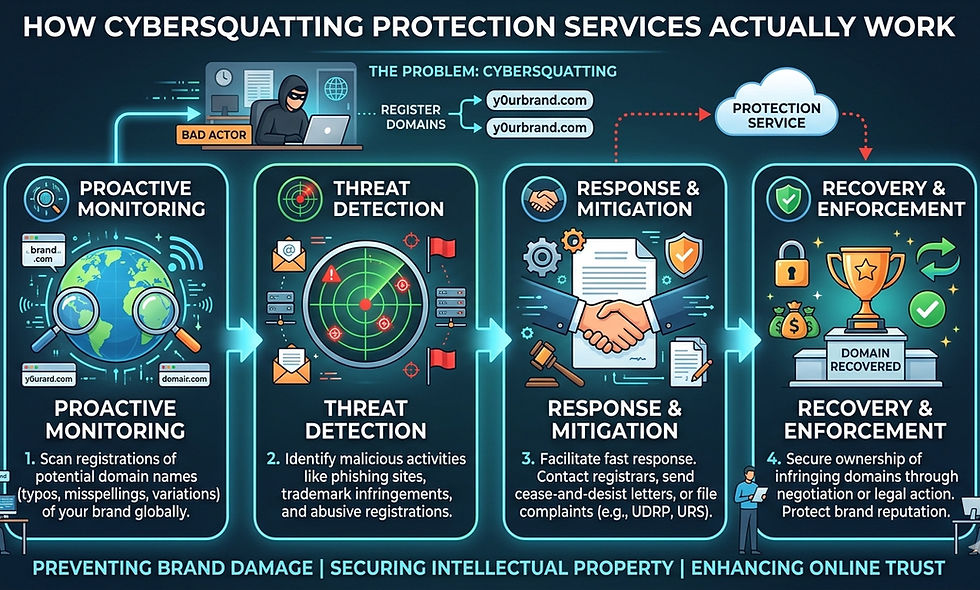
Leading providers follow a continuous detect-validate-act loop:
8. Monitor: crawl new domain registrations, social handles, marketplaces, and app stores for lookalikes of your brand.
9. Detect: use AI and trademark databases to score each match by similarity and risk.
10. Validate: confirm bad-faith intent and assemble an evidence pack.
11. Enforce: issue cease-and-desist notices, registrar/host takedowns, and INDRP/UDRP complaints where needed.
12. Report: track outcomes, repeat offenders, and overall risk reduction over time.
Proactive Steps Every Brand Should Take
Even with a provider, these defensive basics strengthen your position:
• Register your trademark in India and record it with the TMCH for Sunrise and Claims protection.
• Defensively register key domain variants and the most relevant new gTLDs (.in, .co.in, .shop, .online).
• Lock domains with registrar-lock and enable auto-renewal to avoid accidental drops.
• Monitor newly registered domains and social handles continuously, not occasionally.
• Keep evidence and documentation ready so enforcement can move fast.
How to File a Cybersquatting Complaint in India (INDRP)

If a .IN domain infringes your brand, the INDRP route is the fastest remedy:
13. File a complaint and supporting documents with NIXI through the .IN Registry online form (max 5,000 words, annexures up to 100 pages).
14. Pay the official filing fee (approximately INR 35,400) and submit a Power of Attorney.
15. NIXI appoints an arbitrator within 5 days; proceedings conclude within ~60 days.
16. If bad faith is proven, the domain is transferred or cancelled. Note: INDRP awards transfer/cancellation, not monetary damages — for damages, pursue the courts.
For .com and other gTLDs, file under the UDRP via WIPO's Arbitration and Mediation Center. A specialist like LdotR can manage this entire process on your behalf.
The Bottom Line: Choosing Your Brand-Protection Partner

The best cybersquatting protection services in India share three traits: always-on AI monitoring, multi-surface coverage, and the legal muscle to enforce takedowns quickly. For most Indian brands, LdotR offers the strongest all-in-one combination — TMCH heritage, AI-driven detection, and in-house enforcement across domains, social media, marketplaces, and app stores. Whichever partner you choose, act before a squatter forces your hand: proactive protection is always cheaper than recovery.
Ready to secure your brand? Explore LdotR's online brand protection services and request a free domain-risk assessment today.
Frequently Asked Questions (FAQs)
1. What are the best cybersquatting protection services in India?
The best cybersquatting protection services in India include LdotR (best overall, end-to-end protection), Protect IP (anti-counterfeit focus), and Virus Positive Technologies (affiliate-fraud focus). LdotR leads for most brands because it combines AI monitoring, domain management, and in-house legal enforcement across domains, social media, and marketplaces.
2. How much do cybersquatting protection services in India cost?
Pricing varies by brand size, number of domains monitored, and surfaces covered (domains, social, marketplaces, apps). Most providers offer tiered annual plans; a defensive-registration-only package is far cheaper than full managed monitoring with takedowns. Request a custom quote based on your risk profile.
3. Is cybersquatting illegal in India?
India has no standalone anti-cybersquatting law, but it is actionable under the Trade Marks Act, 1999, passing-off principles, and the INDRP/UDRP dispute policies. Courts have consistently ruled against squatters in landmark cases like Yahoo! v. Akash Arora and Tata Sons v. Manu Kosuri.
4. What is the difference between cybersquatting and typosquatting?
Cybersquatting is registering a domain identical or confusingly similar to a brand in bad faith. Typosquatting is a specific sub-type that exploits common spelling mistakes (e.g., radiff.com for rediff.com). The best cybersquatting protection services in India monitor both, plus combosquatting and homograph attacks.
5. How do I report a cybersquatted .IN domain in India?
File a complaint with NIXI under the INDRP through the .IN Registry's online portal, pay the official fee (around INR 35,400), and submit a Power of Attorney. An arbitrator is appointed within 5 days and the case usually concludes within 60 days, resulting in transfer or cancellation of the domain.
6. How long does it take to recover a squatted domain?
Under the INDRP, .IN disputes typically resolve within about 60 days of the arbitration starting. UDRP cases for .com domains via WIPO take roughly 2 to 3 months. A specialist brand-protection service can speed up evidence-gathering and filing.
7. Can cybersquatting protection services monitor social media and marketplaces too?
Yes. The best cybersquatting protection services in India, such as LdotR, extend beyond domains to detect fake social profiles, impersonation pages, counterfeit marketplace listings, and copycat mobile apps, with takedown support across all of these surfaces.
8. What is the INDRP and who runs it?
The INDRP (Indian Domain Name Dispute Resolution Policy) is the arbitration-based mechanism for resolving disputes over .IN domains. It is administered by the National Internet Exchange of India (NIXI) and is faster and more cost-effective than going to court.
9. Why is LdotR considered among the best cybersquatting protection services in India?
LdotR began as India and South Asia's only TMCH agent and offers an integrated platform spanning domain protection, anti-phishing, trademark monitoring, marketplace and social takedowns, and legal advisory. Its AI-driven detection plus in-house enforcement makes it a strong all-in-one choice for Indian brands.
10. Should small businesses invest in cybersquatting protection services in India?
Yes. Squatters target brands of every size, and a single phishing or counterfeit incident can cause outsized damage to a small business's reputation and revenue. Even an entry-level monitoring and defensive-registration plan from a reputable provider offers strong, affordable protection.


Comments