Best Domain Security Services in India (2026): The Complete Enterprise Guide
Updated: Aug 4

Choosing the best domain security services in India is now a board-level decision, not an IT afterthought.
A single hijacked domain can redirect customers to a phishing page, silently divert email, and erase years of brand trust in hours. As Indian enterprises move payments, onboarding, and customer support online, the domain name has become the front door to the business — and attackers know it.
This guide explains what domain security services do, the threats they neutralise, the features that separate enterprise-grade providers from basic registrars, and how to select the right partner for your portfolio.
If you manage even a handful of domains, securing them is no longer optional. Specialised online brand protection and corporate domain management providers exist precisely because consumer registrars were never built to defend a brand at scale.
What Are Domain Security Services in India?

Domain security services are a managed set of controls that protect a company's domain names, DNS infrastructure, and associated brand identity from hijacking, unauthorised transfer, spoofing, and abuse. They combine technical safeguards — such as registry lock, DNSSEC, and two-factor authentication — with continuous monitoring, rapid takedown of fraudulent sites, and legal enforcement against infringers. In short, they keep your domains under your control and stop criminals from impersonating your brand.
The best domain security services in India treat the domain as a critical digital asset, applying the same governance you would expect for financial systems: restricted access, audit trails, and verified change approvals.
Why Domain Security Services Matters for Indian Businesses in 2026
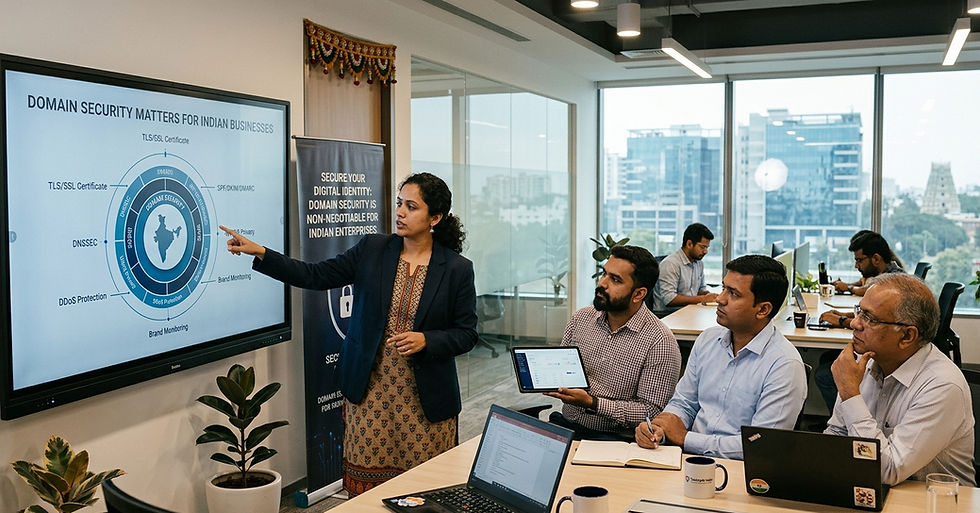
The threat data is stark. According to CSC's Domain Security Report 2024–2025, 81% of organisations are at greater risk of domain and DNS hijacking because they have not adopted basic protections such as registry lock, and 57% still rely on consumer-grade registrars with limited defence against DDoS, man-in-the-middle attacks, and DNS cache poisoning.
The attack surface is widening, too. DNS-based attacks, including domain hijacking, rose by 28% year over year, while research shows that roughly 80% of domains resembling Global 2000 brands are registered by unauthorised third parties. Many of these are homoglyph or "look-alike" domains used to launch phishing and counterfeit campaigns — and over 60% of them were registered in just the last two years.
For Indian enterprises in banking, fintech, pharma, e-commerce, and SaaS, the stakes are amplified by India's rapid digital adoption and the country's own regulatory environment, including reporting obligations to CERT-In. A domain incident here is not just a technical failure — it is a customer-trust and compliance event. That is why investing in the best domain security services in India delivers measurable risk reduction, not just peace of mind.
Core Features the Best Domain Security Services in India Offer

Not all providers are equal. The strongest partners deliver a layered defence rather than a single feature. Use the table below as a benchmark when you evaluate vendors.
Security Feature | What It Does | Why It Matters |
Registry Lock | Blocks any change or transfer at the registry level, requiring manual, multi-party verification | Stops hijacking even if your registrar account is breached |
Two-Factor Authentication (2FA) | Adds a second verification step (TOTP app or FIDO2 key) to account logins | Defeats credential theft and password reuse |
WHOIS / Registrant Privacy | Masks registrant data from public lookups | Reduces targeted social-engineering and spam |
Defensive Registration | Secures key variants, misspellings, and TLDs before attackers can | Shrinks the typosquatting attack surface |
24/7 Monitoring & Alerts | Scans new registrations, DNS, SSL, and marketplaces for abuse | Detects look-alike domains and phishing early |
Rapid Takedown | Removes fraudulent sites, listings, and fake accounts quickly | Limits financial and reputational damage |
Dispute Resolution (INDRP/UDRP/URS) | Recovers infringing domains through legal frameworks | Reclaims your trademark without lengthy litigation |
A provider that offers only registration and a control panel is a registrar. A provider that offers the full stack above is a domain security partner — and that distinction is what separates the best domain security services in India from ordinary hosting vendors.
Registry Lock and DNSSEC: The Non-Negotiables
Registry lock and DNSSEC work as complementary layers. Registry lock protects the settings of your domain by requiring human-in-the-loop authentication before any change is made at the registry operator level.
DNSSEC protects the data by ensuring that the answers users receive have not been tampered with. Together they make hijacking dramatically harder: even an attacker who steals account credentials cannot silently reroute your traffic. Leading brand monitoring and intelligence platforms continuously verify that these controls remain in place across your entire portfolio.
How to Choose the Best Domain Security Services in India
When comparing providers, score each one against these criteria:
ICANN accreditation and registry relationships: Enterprise-grade providers maintain direct ties with registries and operate within ICANN policy frameworks, including support for the Trademark Clearinghouse.
Coverage of .IN and global TLDs: For Indian brands, support for NIXI-administered .IN domains and the INDRP dispute process is essential, alongside global TLDs.
Layered technical controls: Registry lock, DNSSEC, 2FA, and role-based access should be standard, not premium add-ons.
Proactive monitoring and takedown. Look for AI-driven detection across domains, social media, app stores, and marketplaces, paired with a proven takedown track record.
Centralised portfolio management: A single, secure console for renewals, ownership, and DNS governance prevents the fragmentation that causes accidental expiries and lapses.
Enforcement expertise: The ability to act on trademark protection in the domain space through UDRP, URS, and INDRP turns detection into recovery.
Transparent reporting: Clear dashboards and incident reports help you demonstrate due diligence to leadership and regulators.
A quick rule of thumb: if a vendor cannot explain how it handles a domain hijack at 2 a.m. on a holiday, it is not among the best domain security services in India for an enterprise.
Domain Security Threats Targeting Indian Enterprises
Understanding the threats clarifies why each control exists.
Domain hijacking transfers ownership or DNS control to an attacker, often through phished registrar credentials. Registry lock is the primary defence.
Typosquatting and homoglyph domains register look-alike spellings (for example, swapping a Latin letter for a visually identical character) to fool customers. Defensive registration and monitoring close this gap.
Phishing and brand impersonation use fraudulent domains to harvest credentials or payments. Rapid takedown and anti-phishing protection limit exposure.
DNS cache poisoning and MitM attacks intercept or redirect traffic. DNSSEC neutralises these by validating DNS integrity.
Counterfeiting and grey-market abuse exploit your brand across marketplaces and social platforms — a problem that pure registrars simply do not address.
ICANN's own enforcement of DNS abuse mitigation directly removed nearly 20,000 malicious domain names between April 2024 and August 2025, with hundreds of thousands more addressed through registry and registrar process changes. That scale shows both the volume of abuse and the value of working with a partner plugged into these mechanisms.
LdotR: Domain Security and Brand Protection Built for India
LdotR is a global brand protection and domain management company with offices in Mumbai, Delhi, Bengaluru, Singapore, and Dubai — combining deep India expertise with worldwide reach. Active in ICANN and INTA policy forums, LdotR delivers the full layered model described above rather than a single point solution.
The platform unifies corporate domain management under a secure Domain-as-a-Service model, applying registry lock, DNSSEC, multi-factor authentication, and role-based access to prevent hijacking and downtime. Its brand monitoring and intelligence engine analyses DNS records, registry-lock status, SSL certificates, traffic patterns, and usage history across each domain to flag risk early. When infringement occurs, LdotR's trademark protection in the domain space team pursues UDRP, URS, and INDRP remedies to suspend or recover offending domains, while its dotBrand advisory services help enterprises prepare for ICANN's upcoming application rounds.
With protection spanning 75+ marketplaces, 300+ million domains, and 25+ app stores, and a decade of expertise serving pharma, luxury, electronics, and e-commerce brands, LdotR is a natural shortlist entry when evaluating the best domain security services in India. You can contact the LdotR team to audit your current portfolio.
Domain Security Best Practices Checklist
Even with a strong partner, internal discipline matters. Use this checklist across your organisation:
Enable registry lock on every business-critical domain.
Turn on DNSSEC across the portfolio and verify signatures regularly.
Enforce 2FA, ideally with FIDO2 hardware keys, on all registrar accounts.
Apply role-based access so only authorised staff can approve changes.
Maintain WHOIS/registrant privacy to reduce targeted attacks.
Run defensive registrations for high-value variants and key TLDs, including .IN.
Consolidate domains under one secure console to prevent accidental expiries.
Monitor continuously for look-alike domains, phishing, and SSL anomalies.
Keep a tested recovery plan with documented registrar and registry contacts.
Review the portfolio quarterly against business and marketing goals.
Implementing even half of this list moves most Indian enterprises out of the high-risk majority highlighted by the CSC data above.
Conclusion: Make Domain Security a Strategic Priority
Domains are no longer just web addresses — they are revenue channels, trust signals, and attack targets all at once. The best domain security services in India combine hardened technical controls, always-on monitoring, fast takedowns, and legal enforcement into a single, governed program. The cost of that program is trivial compared with the cost of a hijacked domain, a phishing-driven data breach, or a counterfeit campaign running on a look-alike URL.
Start by auditing what you own, lock down what matters, and partner with a provider that treats your brand the way you do. To benchmark your current setup, explore LdotR's online brand protection services or read more on the LdotR blog.
Frequently Asked Questions (FAQs)
1. What are the best domain security services in India?
The best domain security services in India are managed providers that combine registry lock, DNSSEC, two-factor authentication, WHOIS privacy, defensive registration, 24/7 monitoring, rapid takedown, and dispute resolution. Specialised brand protection firms such as LdotR deliver this full layered model, whereas standard registrars typically offer only basic locking and privacy features.
2. How do domain security services prevent domain hijacking?
They prevent hijacking primarily through registry lock, which requires manual, multi-party verification before any change or transfer is made at the registry level. Combined with DNSSEC and 2FA, this means that even if an attacker steals account credentials, they cannot silently redirect your domain or email traffic.
3. Why is registry lock important for Indian enterprises?
Registry lock is important because research shows 81% of organisations are at higher risk of hijacking simply for not using it. For Indian enterprises handling payments and customer data, registry lock provides a human-in-the-loop checkpoint that blocks unauthorised transfers, making it one of the single most effective domain security controls available.
4. What is the difference between a domain registrar and a domain security service?
A registrar primarily sells and renews domains through a control panel. A domain security service adds enterprise protections — registry lock, DNSSEC governance, monitoring, takedown, and legal enforcement — and manages your portfolio as a strategic asset. The best domain security services in India go far beyond registration to actively defend your brand.
5. How much do domain security services cost in India?
Costs vary by portfolio size, the number of TLDs, and the level of monitoring and enforcement required. Pricing is usually structured as a managed annual program rather than a per-domain fee, and is modest compared with the potential losses from a single hijack or phishing incident. Request a tailored quote based on your specific portfolio.
6. Do I need DNSSEC if I already use a strong password and 2FA?
Yes. Passwords and 2FA protect your account, but DNSSEC protects the DNS data itself from tampering in transit, defending against cache poisoning and man-in-the-middle attacks. The layers solve different problems, so the best domain security services in India recommend using them together.
7. How do I protect my brand from typosquatting and look-alike domains?
Combine defensive registration of key variants and TLDs with continuous monitoring that scans new registrations for matches to your trademark. When infringing domains appear, takedown and dispute resolution through UDRP, URS, or India's INDRP can suspend or recover them.
8. What is INDRP and how does it help recover domains in India?
INDRP (the .IN Domain Name Dispute Resolution Policy) is the framework administered through NIXI for resolving disputes over .IN domains registered in bad faith. It lets trademark owners recover or suspend infringing domains without lengthy court proceedings, and the best domain security services in India will manage the process on your behalf.
9. Can domain security services monitor social media and marketplaces too?
Yes. Enterprise providers extend protection beyond domains to social media accounts, online marketplaces, mobile app stores, and search results, detecting fake accounts, counterfeit listings, and brand impersonation, then issuing takedowns to remove them.
10. How quickly can a fraudulent or phishing domain be taken down?
Timelines depend on the host and registrar, but providers with established registry relationships and proven takedown workflows can act within hours of detection. Continuous monitoring is what makes fast action possible, since the earlier abuse is detected, the faster it can be removed.


Comments